
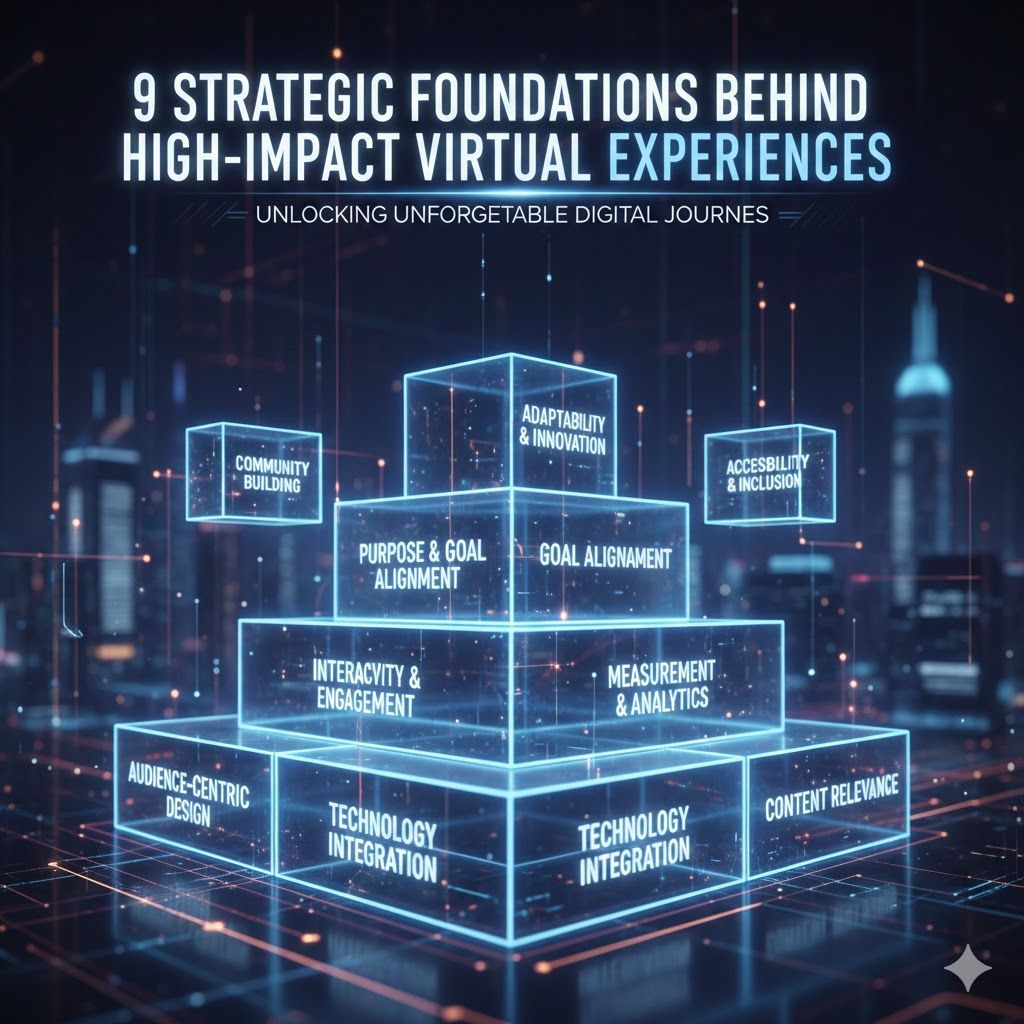
Virtual experiences are now mainstream, not for gamers or tech fans. Today, immersive digital environments are key assets for many industries. These include retail, healthcare, education, real estate, entertainment, and enterprise collaboration. Brands investing in virtual experiences aren’t following a trend; they're embracing a new reality. They’re getting ready for the next phase of digital interaction.
But not all virtual experiences succeed. Many fail due to poor planning, weak user engagement, or a lack of scalability. Strategists build high-impact virtual experiences, not hype. They need a solid base that links technology, user needs, and long-term business goals.
Here are nine key foundations for successful, scalable, and impactful virtual experiences.
1. Purpose-Driven Experience Design
Every successful virtual experience begins with a clear purpose. Without it, even the most visually impressive environments do not generate value.
A strong purpose answers essential questions:
- Who is this experience for?
- What problem does it solve?
- What outcome should users achieve?
The experience should focus on intent, not technology. This applies to customer engagement, training, collaboration, and brand storytelling. Many projects jump into using tools like VR, AR, or 3D environments. They do this before defining their purpose.
High-impact virtual experiences come first. Next, we use immersive technologies to make them even better. Purpose-driven design ensures relevance, clarity, and measurable success.
2. User-Centered Interaction and Accessibility
Virtual experiences only succeed when users can navigate them with ease. Complex controls, steep learning curves, or hardware barriers reduce adoption and engagement.
Developers build modern virtual platforms with:
- Simple navigation
- Familiar interaction patterns
- Clear onboarding flows
Accessibility holds the same level of importance as other factors. Users should access experiences on different devices. This includes desktops, mobile phones, AR devices, and VR headsets. Limiting access to high-end hardware reduces reach and business impact.
High-impact experiences are inclusive by design. They adapt to user behavior rather than forcing users to adapt to technology.
3. Scalable Technical Architecture
Scalability separates short-term demos from long-term platforms. A leading metaverse development service builds flexible architecture that supports growing users, new features, and future integrations, ensuring virtual experiences remain stable, high-performing, and sustainable as business needs evolve.
Virtual experiences must support:
- Growing user bases
- New features and integrations
- Expanding content and environments
A weak technical foundation leads to performance issues, downtime, and high maintenance costs. Scalable architecture ensures smooth performance even as demand increases.
This includes:
- Cloud-based infrastructure
- Modular development frameworks
- Systems designed for future integrations that are compatible with APIs
Strategic planning at the architecture level helps virtual experiences grow. This way, we avoid the need for complete rebuilds.
4. Real-Time Performance and Stability
Performance influences user perception. Lag, latency, crashes, or slow loading disrupt immersion and trust without delay.
We optimize high-impact virtual experiences for:
- Fast rendering
- Stable real-time interactions
- Consistent performance across devices
This requires careful optimization of assets, environments, and backend systems. Performance testing is not optional—it is a continuous process.
Users expect virtual environments to be smooth and responsive, like modern apps. Stability builds confidence and encourages repeat engagement.
5. Meaningful Content and Contextual Value
Technology alone does not create impact—content does.
Virtual experiences must deliver meaningful content that:
- Educates
- Entertains
- Solves problems
- Creates emotional connection
Content should be context-aware and relevant to user goals. A virtual showroom should emphasize product interaction and decision-making, not visuals. A virtual training environment should focus on learning outcomes, not complexity.
High-impact experiences use immersive content with careful consideration. This boosts understanding and retention without distracting users.
6. Cross-Platform and Device Compatibility
Users expect flexibility. They switch devices throughout the day without difficulty. Virtual experiences need to support this.
Designers create high-impact virtual platforms to work across:
- Web browsers
- Mobile devices
- AR systems
- VR headsets
Cross-platform compatibility ensures wider adoption and lower entry barriers. It also future-proofs the experience as new devices emerge.
Consistency across platforms is critical. Users should enjoy a smooth experience, whether using a computer, tablet, or phone.
7. Data, Analytics, and Behavioral Insights
Virtual experiences generate rich behavioral data. When used with careful planning, this data becomes a powerful optimization tool.
Key insights include:
- User movement and interaction patterns
- Time spent in environments
- Drop-off points
- Feature engagement
High-impact virtual platforms integrate analytics from the start. Data-driven insights refine experiences. They improve usability and align features with real user behavior.
Without analytics, leaders base decisions on assumptions. With analytics, experiences evolve based on evidence.
8. Security, Privacy, and Compliance
As virtual environments handle user data, interactions, and sometimes transactions, security becomes non-negotiable.
High-impact virtual experiences focus on:
- Data encryption
- Secure authentication
- Privacy protection
- Regulatory compliance
Users must feel safe while interacting in immersive environments. Trust has a direct impact on adoption, retention, and brand credibility.
Security is not a technical need—it is a strategic foundation for sustainable growth.
9. Long-Term Vision and Continuous Evolution
The most successful virtual experiences are not static. They evolve in response to user feedback, technology updates, and business needs.
A long-term vision includes:
- Regular updates
- Feature enhancements
- Content expansion
- Performance improvements
Treat virtual experiences as living platforms, not one-time projects. Continuous improvement ensures relevance in a digital landscape that undergoes rapid changes.
High-impact virtual platforms grow alongside their audiences, adapting to new expectations and opportunities.
Business Impact of Strong Virtual Foundations
When these nine foundations align, virtual experiences deliver measurable business value.
Organizations enjoy:
- Higher engagement and retention
- Stronger brand differentiation
- New revenue streams
- Improved collaboration and training
- Deeper customer insights
Users enjoy:
- Intuitive interactions
- Meaningful experiences
- Accessible technology
- Consistent performance
The result is a digital ecosystem. It supports lasting growth, not quick experiments.
Why Strategy Matters More Than Technology
Immersive technology will keep evolving, but strategy stays key to success. Tools change, platforms update, and devices get better. But experiences based on solid strategies stay important.
High-impact virtual experiences focus on user needs and business goals, not on technology.
Organizations that build strong foundations will adapt and thrive in the digital future. Chasing trends won't lead to lasting success.
Final Thoughts
Virtual experiences represent a major shift in how people interact with digital environments. Businesses on immersive platforms need to create detailed plans. They need a design that prioritizes user experience. Success also requires scalable execution.
The nine strategic foundations offer a clear guide. They help build virtual experiences. These experiences are impressive. They are also effective, sustainable, and valuable.
When purpose, performance, accessibility, and vision come together, virtual experiences change. They go from fun to valuable digital assets.